E-commerce in Tunisia: The Complete Guide (2026)
Discover how Converty helps ecommerce businesses scale faster with AI-powered tools, advanced analytics, order management, landing pages, and fake order protection—all in one platform.
E-commerce in Tunisia: The Complete Guide (2026)
E-commerce in Tunisia is quickly becoming every young entrepreneur's first move—and once you do the math, you'll understand why. A physical store means rent, staff, and an architect just to get people through the door, easily 100k+ before you've made a single sale. E-commerce cuts all of that out.
This guide walks through what's driving that growth, what sells, how to launch, and how to scale once the orders start coming in.
Why E-commerce in Tunisia Is Growing Fast
According to DataReportal's Digital 2025 report, 84.9% of Tunisians are now online (source: datareportal.com). With that has come a real shift in trust—buying from a page discovered on Instagram no longer feels as risky as it once did.
Facebook, Instagram, and TikTok have become powerful product discovery channels. At the same time, delivery networks have become faster and more reliable, while building a professional online store no longer requires technical skills or a large budget.
Together, these changes have made e-commerce in Tunisia one of the fastest and most accessible ways for entrepreneurs to test a business idea—without paying for a physical store, holding inventory in a rented space, or taking on significant upfront costs beyond the product itself.
What Sells Online in Tunisia
Almost anything can sell online if there's real demand behind it and a solid marketing strategy to support it. That said, some product categories consistently perform well, including:
- Fashion and accessories
- Beauty and cosmetics
- Electronics and gadgets
- Home décor
- Kitchen products
- Sports equipment
- Baby products
- Food and specialty items
- Digital products
The common factor among successful online stores isn't the category—it's focus. A store built around solving one specific problem for one specific customer is more likely to outperform a store trying to be everything to everyone.
How to Start an Online Store in Tunisia
Launching an online store today is much easier than it was just a few years ago. Here's the path most successful merchants follow.
1. Choose a Niche You Can Defend
Before building anything, validate your business idea by answering these five questions.
Check Demand
Use the following tools to evaluate market demand:
- Google Trends — Search for your product and see whether interest is growing, stable, or seasonal. Products with consistent year-round demand are generally less risky than highly seasonal ones.
- Meta Ads Library — Search for your product category and review active ads in Tunisia. Few or no ads may indicate an untapped opportunity—or low demand. Ads running consistently for several months usually signal a profitable market.
Check Competition
Analyze your competitors before entering the market.
- Review how long competitors' ads have been running in the Meta Ads Library. Long-running campaigns often indicate profitability.
- Search Google to determine whether a few major Tunisian stores dominate the niche or whether it's fragmented across many smaller sellers. Fragmented markets are generally easier to enter.
Check Supplier Availability
Cash on Delivery: Still King in E-commerce Tunisia
Cash on Delivery (COD) remains the payment method most Tunisian shoppers trust. It's not simply a preference—it's the default. COD is estimated to account for around 70% of e-commerce transactions in Tunisia (source: lloydsbanktrade.com).
Why COD Dominates in Tunisia
Several factors explain why COD continues to lead the market:
- Low trust in online card payments — Online card adoption remains lower than in many European and Gulf countries.
- Greater customer confidence — Shoppers often trust paying the delivery agent more than paying an unfamiliar website in advance.
- Higher conversion rates — Offering COD allows businesses to reach customers who might otherwise abandon their purchase instead of paying online.
The Real Operational Cost—and Why It Isn't a Burden
COD isn't a drawback of doing business in Tunisia—it's the trust mechanism that drives the local e-commerce market.
Every merchant selling online faces the same challenge. The businesses that succeed are the ones that optimize their COD operations instead of trying to eliminate them.
They build efficient processes around:
- Order confirmation calls
- Fraud prevention
- Delivery partner selection
Together, these practices help reduce failed deliveries, improve customer trust, and keep operations running efficiently.
The Challenges Every Merchant Eventually Faces
Regardless of what you sell, a handful of obstacles tend to appear as your business grows. Each one is a systems challenge—not a sign that you're doing something wrong.
Order Volume Outgrows a Spreadsheet
What starts as a manageable list can quickly turn into missed orders, duplicate entries, and confusion over what's been confirmed, shipped, or delivered.
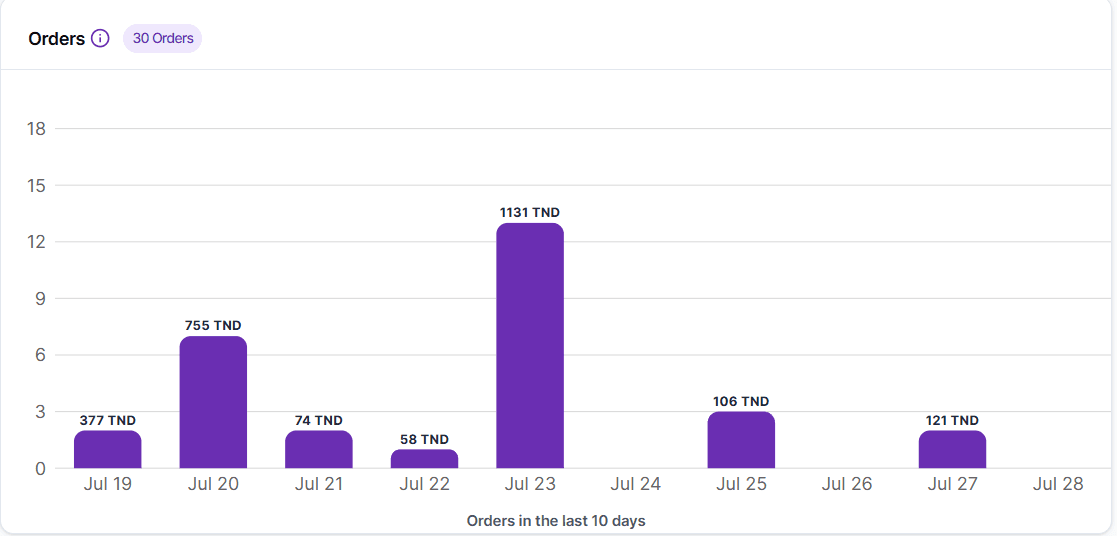
Converty centralizes every order—from every sales channel—into a single dashboard.
Inventory Swings Between Overselling and Dead Stock
Without real-time inventory tracking, merchants either sell products that are out of stock or hold inventory that never moves.
Converty tracks inventory in real time, so you always know what's available before confirming a sale.

Delivery Coordination Breaks Down Across Couriers
Managing multiple delivery companies manually often leads to delays, errors, and a poor customer experience.
What an E-commerce Store Actually Needs Under the Hood
Most merchants start by selling through social media alone—and that's a perfectly reasonable way to begin. But as order volume increases, the cracks start to show. This is where the platform running your business behind the scenes becomes just as important as the storefront itself.
The Essentials—and What Happens Without Them
As your business grows, relying on scattered tools becomes increasingly difficult. A modern e-commerce store should include:
- Product management
- Automatic inventory synchronization
- A powerful Order Management System (OMS)
- Delivery integrations
- A centralized customer database
- Built-in marketing tools
- An analytics dashboard
- Mobile optimization
- A checkout designed to maximize conversions
- Multi-user access for team collaboration
Without these essential features working together, merchants often face inventory errors, delayed orders, duplicate work, and limited visibility into their business.
📷 Insert screenshot of Converty's unified dashboard showing orders, inventory, and delivery in one view
Why Consolidation Wins Over Five Disconnected Tools
Scaling: What Comes After the First Sales
Once sales are steady, the temptation is to add more products. The merchants who actually scale tend to resist that and focus on optimization instead.
What Scaling Actually Looks Like
Scaling isn't just about expanding your catalog. It involves:
- Raising average order value
- Improving conversion rates
- Reducing cart abandonment
- Building customer loyalty
- Running retargeting campaigns
- Expanding thoughtfully
- Automating repetitive tasks
The Middle East and Africa region sees an average cart abandonment rate of 93%—the highest of any region globally (source: sellerscommerce.com), compared to a global average of 70.22% (source: baymard.com). Closing even a fraction of that gap can have a greater impact than simply adding more products.
📷 Insert screenshot of Converty's retargeting/campaign performance view
How Converty Supports That Shift
Converty was built around the reality of what merchants in e-commerce Tunisia actually need, from the first product listing to thousands of monthly orders.